Thursday, 25 September 2014

Getting back on it


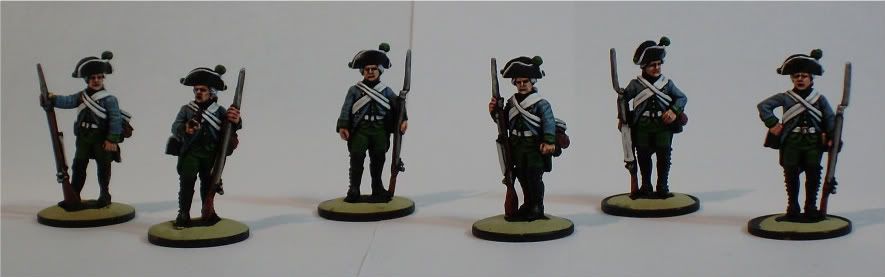
It's been a good while now since I put paint to a 18th century miniature. I've been painting plenty of figures from other periods, but this weekend I'm hoping to get cracking on the above.

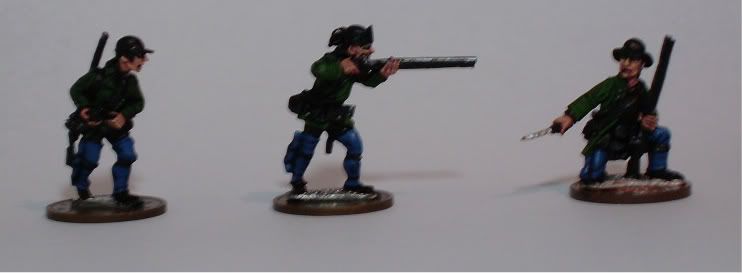
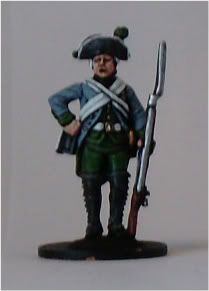
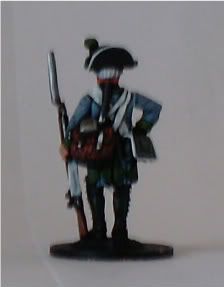
The photo is pretty awful (still getting to grips with this phone camera), but the figures in front are Ebor Miniatures WSS figures. First off, these figures are beautiful - brilliant sculpted by Paul Hicks, and well cast by Ebor (or whoever does their casting). On top of that, these miniatures are really good value at £1.10 a piece, and the fact you can buy them individually means that you're not buying miniatures that won't be used due to the way they're packaged. Altogether the WSS miniatures above make a 4 point Dutch force for the League of Augsburg's 'Donnybrook' rules.

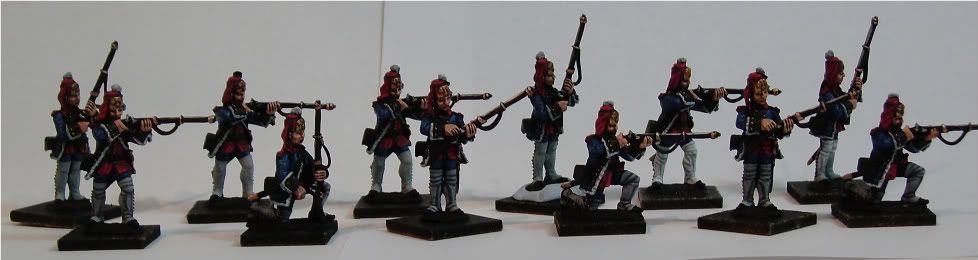
The figures at the back are conversions (and rather rough and ready ones at that). They were done nearly two years ago now, and are an attempt to turn some of the Perrys' AWI Queen's Rangers into Savolax Jagers for the Russo-Swedish War of 1788 to 1790. This little project stalled when I began to realise just how much work would be involved with the figures I was planning on using for the Swedish infantry. Recently, some new releases of figures and head sets have made the project much more manageable for a person like myself, with little in the way of conversion skills (and even less patience). The aim is to convert a small force for both sides of this somewhat obscure conflict, for use with the Lardies' Sharp Practice rules. Converting these taught me a couple of important lessons that will help me with the project - don't make a rod for your own back, and be prepared to settle for 'good enough'.

I'll be undercoating all of these this weekend, but will probably only be making a start on the Dutch, due to not having suitable paints for the light green coats of the Savolax Jagers.

Thursday, 18 September 2014

Free articles on the Seven Years' War and The '45

An officer of the Regiment de Clare, 1767
 

About a year ago I started compiling links to articles that are now accessible for free on Jstor. The articles are taken from various historical journals and have been subdivided into four sections. I haven't had the chance to look at many of them yet but, just going from the titles, I suspect that 18th century wargamers will be bound to find something of interest. As more US, Irish and Scottish historical journals appear to be accessible, subjects related to those countries are more heavily respresented.

Although these articles are accessible for free, you will have to register with Jstor. You will also be restricted to viewing only three articles every two weeks, in the UK at least (or 'the countries formally known as the UK', depending on what happens in the next few hours). But that's a small price to pay to have otherwise free access to this resource.


I'll carry on digging around the internet for more, and will add them to the relevant pages as I find them.

Sunday, 24 June 2012

Blimey, that was a gap.

Hi everyone. I thought I'd better do an update before Blogspot deletes this thing through inactivity. September to June is quite a gap and, although I've not been posting on here, I've been busy, particularly in the last month. A few weeks ago I decided it'd be a good idea to put on a small Very British Civil War display game on one of the Manchester Area Wargames Society tables at Phalanx 2012 but, needing to wait until payday for most of the materials, it ended up just being a mad week-and-a-half rush with no sleep the night before.

I'd decided I wanted to do a locally themed layout and went for the typical terraced houses of a Lancastrian town and a colliery with headgear (of which all but one have disappeared from our fair county). It soon became clear that I'd seriously underestimated the amount of time it would take to build terrain and it wasn't until the last day that I'd finished building the terrain, and painting was only started in the afternoon. There was a little disaster that means bits will need redoing. Not having enough time to cut out strips of roof slates, I decided to cut a corner by scoring a pattern into pieces of textured thin card for both the roofs and the pavement flagstones. The pavement stuck down fine but didn't pick up the drybrush so I will have to paint the flagstones individually (eek). The roofs were much worse. Being the first time I'd made terrain I had no idea the degree to which the card could warp due to the glue. I'd added superglue dots of superglue to the card as well as the watered down white glue, and whilst the superglued bits stayed in place, the bits with just the white glue started to come away from the foamboard and actually bend it outwards as well. The roofs will have to be redone but at least I'll have time to do a proper job this time. I'll also be adding windows, doors, civilian vehicles and some street furniture. One of our club members (SuicideBadger) took a few photos at Phalanx and has done a write up of the event on the MAWS 40k blog. I've nabbed a couple to post here, mainly to show that I'm not a complete slacker.

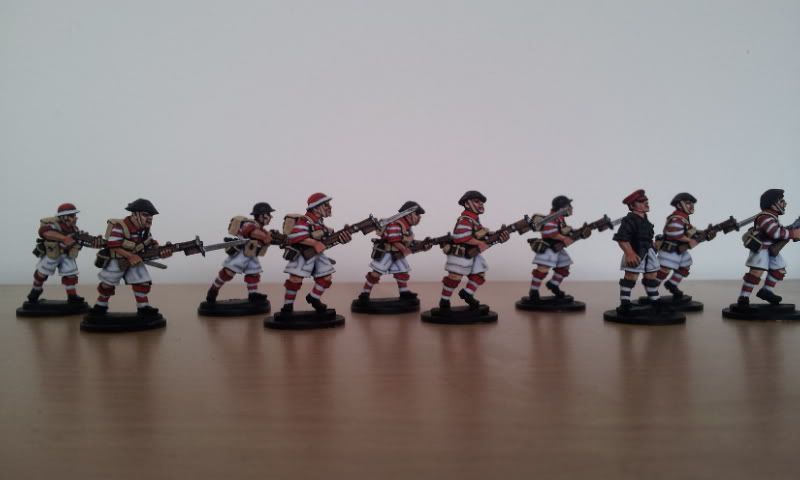
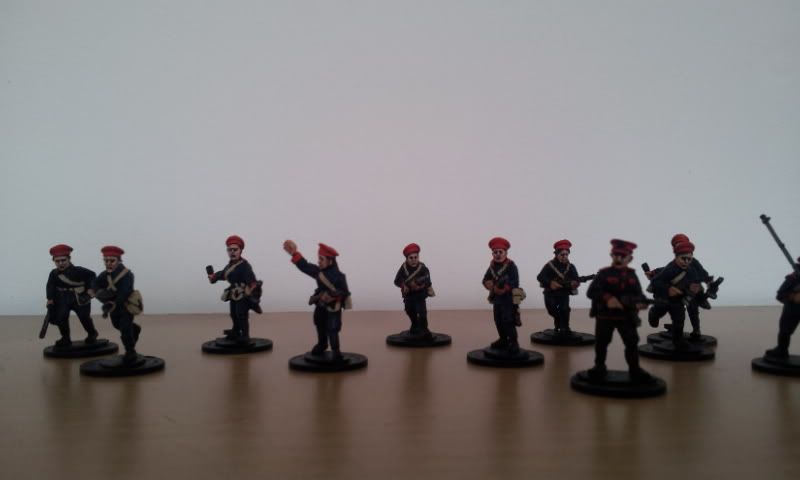
The starting position for both small forces. I'd only managed to get twenty or so Wiganers and Liverpudlians (and only started painting Artizan's miniature of George Orwell at 5.30 on the morning of the show).

Wigan Rugby players and Liverpool Revolutionary Sailors in their starting positions.

A WIP photo of the Rugby players under natural lighting rather than that in the Sports Hall, that I originally took for a project log on the new VBCW forum.

And a WIP photo of the Sailors

I really enjoyed the show and it was great getting to meet loads of new gamers and have a good chat. I think there will definitely be another game done for next year, but it won't be a complete rush job again. I'm not sure whether it'll be VBCW or something else.

I've also actually started to reach the point where I'm beginning to enjoy the painting part of this hobby (or at least not finding it as much of a chore) and over the next couple of days I'm going to be painting some archers from GW's Bretonnian range of about 1990. These figures in particular and nice to paint and are essentially just early 14th century English Archers with no fantasy elements modelled on them at all - but loads of nice detail like gloves stuffed into belts etc. Then over the next couple of weeks I'll be painting up some French Infantry for a Muskets and Tomahawks game which means (drumroll) that after 2 years this '18th Century Painting blog' will soon have some painted and based 18th Century miniatures on it.

I also recently bought some 18th Century miniatures last month for a new project but more on that when I get round to it.

Anyhow, back to the painting.

Thursday, 15 September 2011

Uniforms of Genoa and Modena

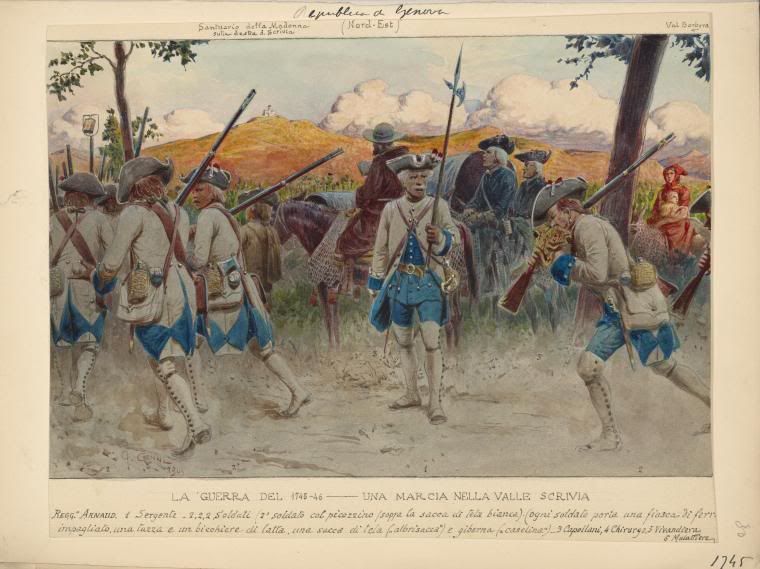
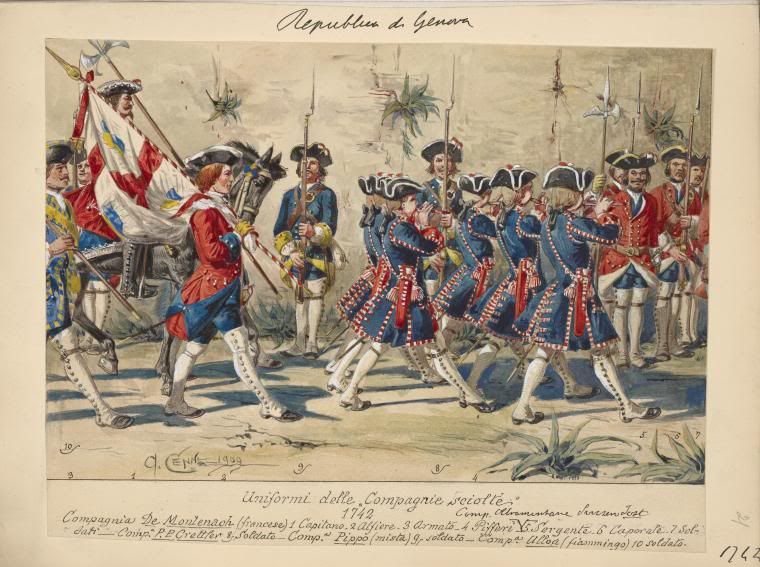
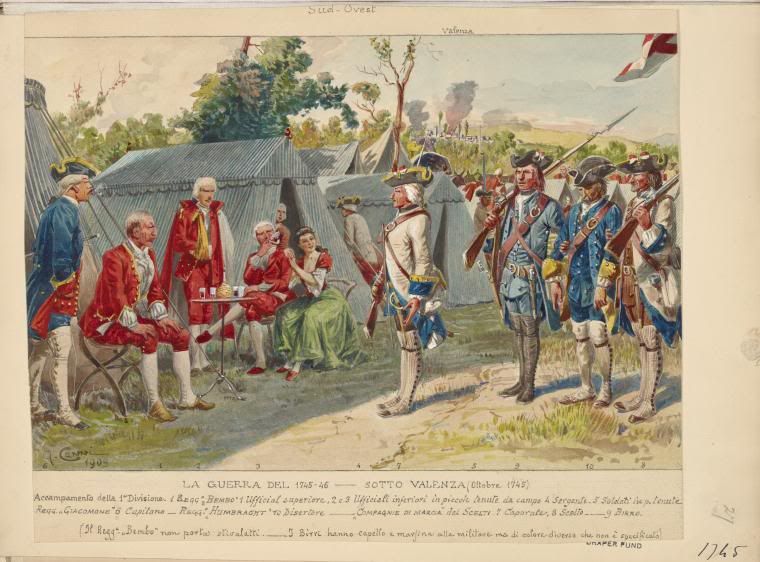
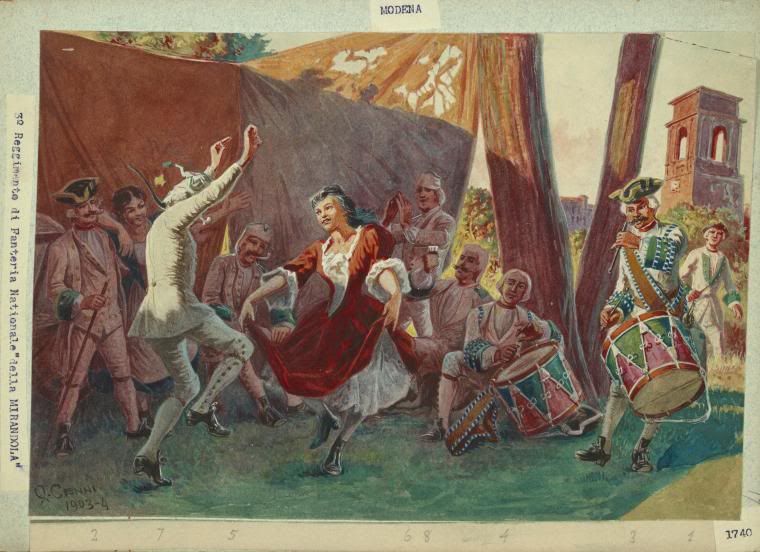
Recently I've been taking a bit of a detour through the War of the Austrian Succession with my reading and at the moment the campaigns in Italy have particularly grabbed my attention. I think the uniforms were what drew me in initially, especially those of Savoy which are beautiful in their simplicity. That, and perhaps the scarcity of books in English on the subject initially gave it an air of mystery. For the past week or so I've been reading Duffy's The Wild Goose and the Eagle and when I reached the section dealing with the fighting against Genoa I remembered some absolutely lovely plates on the New York Public Library's Vinkhuijzen collection of military uniforms. I first ventured there a couple of years ago and spent most of my time perusing the sections on the big players (Prussians, Austrians, French, etc.) but there are some real gems hidden in some of the smaller nations so I thought I'd post a few and the links to them, as they are really worth a browse if you get chance.

The plates in question all seem to be done by the same artist and cover the uniforms of Genoa and Modena. There are also some more by him of later Italian uniforms from the French Revolutionary Wars onwards. All of the plates take the form of scenes and this gives them a real character and charm. I don't know the artist's name, but if you happen know anything about them (who did them, did he do any other mid 18th century, are books available with them in etc.) please let me know in the comments section of this post. I'd be very grateful for any help you can give. 

Anyway I'll stop waffling on now and post a few pictures:

Genoa 

A little bit of information on Genoese uniforms can be found on Uniformology's website.


 Officer reading a message while Swiss and Genoese soldiers, and what I think is a scout or light infantryman of some kind, look on.

Genoese soldiers march down a dusty Italian road under the watchful eyes of their sergeant.

Swiss infantry marching behind their fifers.

A rather forlorn-looking Piedmontese prisoner (from a Swiss regiment, I believe) is brought before relaxing officers and a lady.


Modena

A soldier and follower dance in camp.

 Swiss soldiers go for a stroll.

A selection of uniforms, I particularly like the combination of colours on the two gossiping in the middle.

Towards the end of the century a soldiers' fight rapidly escalates into bloodshed.

If you haven't been on the New York Public Library's Vinkhuijzen collection of military uniforms I can't recommend it enough. It's great that such a valuable resource has been made public, and on top of that they actively encourage sharing by providing links to embed the pictures in your own websites. More plates by the same artist as did these can be found in the Italy section under Genoa, Modena, Italy 1796-97, Minor States and probably more besides.

My painting has stopped completely over the last few months as I've been cramming in as much overtime as I can but I hope to get something posted in the next couple of weeks or so. I really can't let myself down this month. I've got a bit of extra motivation, though, because as soon as I get through the stuff I have on the go already I can get on to painting some lovely Minden Miniatures hussars currently sitting in the cupboard.

A few more books


I've added a few more books to the Seven Years War book list (although one is strictly about the War of the Austrian Succession):

Irish Brigades

By John Cornelius O’Callaghan

By Mary Anne Bianconi O 'Connell

By Andrew O’Reilly


War of the Austrian Succession


By Richard Rolt

Monday, 28 March 2011

New additions to the French and Indian War Free Book List


When I initially posted the list of French and Indian War books on TMP, forum member Thomas Mante very helpfully suggested some more related books (thanks!). That was a few months ago, but I've pulled my finger out and added them to the list now. I've listed the new additions below to save you searching through the list if you've already downloaded the ones that were there before:

PRIMARY SOURCES

British


By George Washington

By Mary Carson Darlington (includes the letters of Generals Grant, Forbes and Bouquet, and the Journal, letters and orderly book of Captain Simeon Ecuyer

(includes extracts from the papers of Colonel Henry Bouquet)

By Robert Rogers, John Bradstreet and Franklin Benjamin Hough

French

By James Johnstone

By Mary Carson Darlington (includes account by Pierre-Joseph Céloron de Blainville)

SECONDARY SOURCES

By William Harrison Lowdermilk

By Mary Carson Darlington

By Mary Carson Darlington
By William Smith

Sunday, 27 March 2011

A little bit of progress on the painting front

Well, I've had a sudden burst of painting energy and am getting ever close to my (rather pathetic) goal of finishing my first unit. I've been helped along the way by Channel 4's '4OD' service where they have uploaded large sections of their back catalogue for free viewing on the internet (without a one-week-to-view limit like the BBC). So whilst I've been getting down to it, I've re-watched the Devil's Whore and The Book Group, on top of my usual wrestling, Corrie and ANTM painting TV programmes. Corrie has been especially good this past week with Becky's antics, including a particularly nasty (for corrie at any rate) fight with her sister and David Platt before going to work behind the bar without bothering to clean herself up. It  isn't this violent usually and I think three bloody noses within the space of a minute is a record for Corrie. Becky certainly proved that she is anything but 'all talk' and I'll be gutted if Katherine Kelly doesn't get best soap actress at the next TV awards. But enough waffling about soaps, I'm sure you all have to put up with listening to enough of that in real life, and I don't think my attempt to increase my blog content by substituting soaps for actual painting is fooling anyone.


Frei-regiment von Gerlach WIP

First up, Frei-regiment von Gerlach. I've decided to carry on using the Perry musketeers at ease for these. At one point I was thinking of changing to something more 'actiony' which would suit troops not firmly ranked up, but that was really down to being unsure of how a Frei-regiment would operate. The decision to carry on using these came from reading Duffy's Instrument of War (thank goodness for inter-library loan) in which Duffy says this with regard to the Green Loudon regiment:

'As a full regiment his troops would be able to lend solid support to the Croats, who had a way of dispersing after a successful attack'

I'm taking this to apply to von Gerlach as well, that they are there to provide solid support (which won't disperse) to the Jaegers who will fight in a 'skirmish' order. I'll be ranking the miniatures up using some of the one penny movement trays from warbases.co.uk, which will also allow easy casualty removal as I'm planning on using the Sharp Practice ruleset. Usefully, posting this picture has made me realise that I've missed the belt off of one of them which would have got me miffed if I'd only noticed it after varnishing them all.

Arquebusiers de Grassin WIP

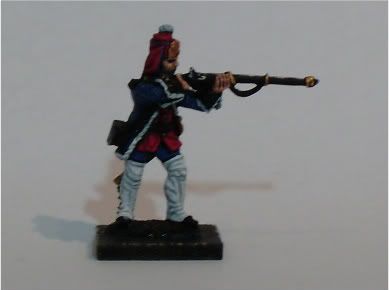
Next up are some Arquebusiers de Grassin. I've got 24 in total and these are the first 12. You'll probably notice the gaiters are all different colours. The grey triad on the front row is what will be used for the models rather than the white, which was too much of a chore to paint on the few I tried it on. I quickly realised I wouldn't be able to get through 24 sets of white gaiters when I was getting frustrated with the first few. Thankfully there are a number of different depictions of the Arquebusiers de Grassin and one of these includes them wearing grey gaiters (below). The switch to grey has noticably affected my painting rate, as I am now able to overcome my laziness to do longer painting sessions on the Grassins.

Grey gaiters

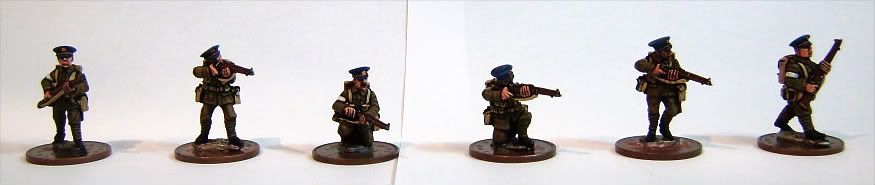
Finally, I've been interspersing something a little different between the SYW stuff in the form of some Very British Civil War Royalist territorials (I've shamelessly jumped on that bandwagon). I've found it really helps me to vary what I'm painting to stop me getting too bored, as well as giving me the opportunity to paint up some Great War British I impulse bought a couple of years ago. VBCW also gives you a bit of freedom to use your imagination so I've given them blue dress caps (think Whites in the RCW) and white armbands. These ones are finished apart from the basing.

Lancashire Fusiliers, assigned to the detachment tasked with defence of Royalist supply lines to the forces on the Liverpool Front, in the Leigh and Tyldesley area .

I think the most important thing at the moment, though, is that I've managed to get myself back into work which means I'll be able to structure my painting over work night evenings. It also means I'll be able to unable to resist buying more stuff which is probably a bad thing. I'm set on doing some AWI and some 15mm SYW, but every time I check the internet there seems to be a new range that I feel compelled to buy. I really don't think I'll be able to resist the new Empress Maori Wars range, for example.

Oh, and from now on I won't start going on about what TV I've been watching on this 'wargaming blog'. It's just that Corrie at the moment has been too good for me to be able to resist the compulsion to subject all and sundry to my opinions on it. Sorry.

Friday, 14 January 2011

Test/practice models

"This blog is an attempt to motivate myself to paint Seven Years War wargames armies with the aim of posting something new every month."

Well, seeing as that was the stated aim of this blog when I started it months ago, I'd say with certainty that I haven't really done what I set out to do. In fact every time I look at my own blog that sentence grates on me, reminding me of my own slothful ways. Thankfully, I've begun to make some progress, even to the point where painting is starting to become enjoyable rather than a chore. I think purchasing a daylight bulb and Argos' cheapest floorlamp has helped with this. It's enabled me to paint for a lot longer in the evening and, more importantly, enabled me to combine this hobby with my main couch potato activities. No longer will Coronation Street, TNA Wrestling, X factor (though I'll have to wait another year) and the like have to be in a seperate sphere to wargaming. With these sorts of thing I tend to only be interested in some of it so I can concentrate on painting whilst just listening and only look up if something interesting's happening. Like John Stape comedically tampering with a crime scene, Mrs Karen Jarrett schreeching at ex-husband Kurt Angle, or saucy scouse songstress Rebecca Ferguson making 'Candle in the wind' her own. I suspect that some of you will now be of the opinion that, apart from 18th Century military history, my interests are decidedly low brow, but I'm unashamed and if it helps me paint more it can only be a good thing.

Anyway, I started my painting off with some French and Indian War Rangers. These aren't finished yet, as they were mainly a means to try out a number of different colours for my SYW skirmish 'project'. Especially to find red, blue and dark green triads I'm happy with.

Trying out a red

Trying out a blue

After these experiments with colour combinations I painted a test model from the unit i hope to complete next (first, in fact), the Arquebusiers de Grassin. I think I will be doing this on all units from now on as this one proved to be very helpful in deciding the order I paint the various part of the miniature in. On this one I left the fur trim until near the end, which proved to be a bad move as, even when using a relatively small brush, white paint started going on other bits of the miniature whilst drybrushing, which I then had to touch up. All that remains now is the musket woodwork and the cartridge box and strap. I did actually find a couple of browns I liked that would have suited this purpose a couple of years ago, but I neglected to write them down at the time and now the miniatures they were used on taunt me from the shelf.

Arquebusier de Grassin

One thing I have definitely learnt from making this post is that the expression 'the camera never lies' is an out and out lie itself. I assure you that up close it is clear that I have slapped the paint on thick and chalky, and that the eyes on the Rangers look so goggly that I didn't bother trying to paint them on the Frenchman as  I don't want them to look high as kites as well. Apologies for the dark and blurred nature of the photos, even if it does work to my advantage.

Hopefully, I will be posting a photo of these Frenchmen at the end of next weekend if not before. After that, a change of tack as some local gamers have very kindly allowed me to join in with their 28mm AWI and 15mm SYW projects. So you should soon be seeing some Americans and Hanoverians on this blog.

Thursday, 23 December 2010

Sothebys Archive

Hiya

I've been doing a bit of searching on the Sothebys auction archive over the past couple of months and, while there aren't lots of SYW-related items, it does seem to throw up the odd really interesting piece now and again. I'm a bit wary of uploading lots of pictures from their site, as I'm not sure of how the image rights work with recently sold paintings, but a few seemed too useful or interesting not to share.

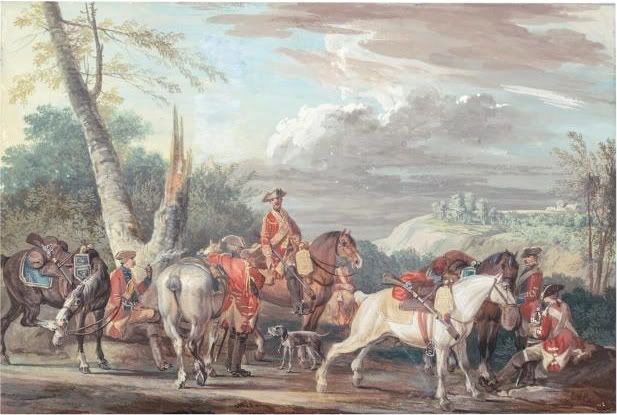
'Cavalry Party at Rest by the side of a Road' by Jean-Baptiste Le Paon

This first image is a period image of either British or Hanoverian cavalry at rest (I think but would be happy to be corrected) and seems to be a quite useful depiction of the uniforms and horse furniture of whichever units these men are from.

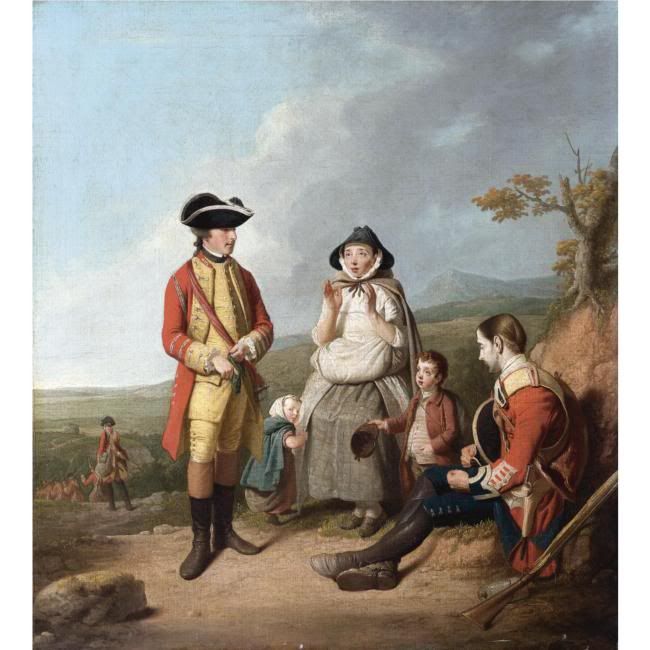
'An officer relieving a sick soldier' by Edward Penny

Look familiar? This stood out immediately to me, as it is essentially the same painting as Penny's famous depiction of Granby, but with Granby replaced by an officer of the 3rd Irish Horse.

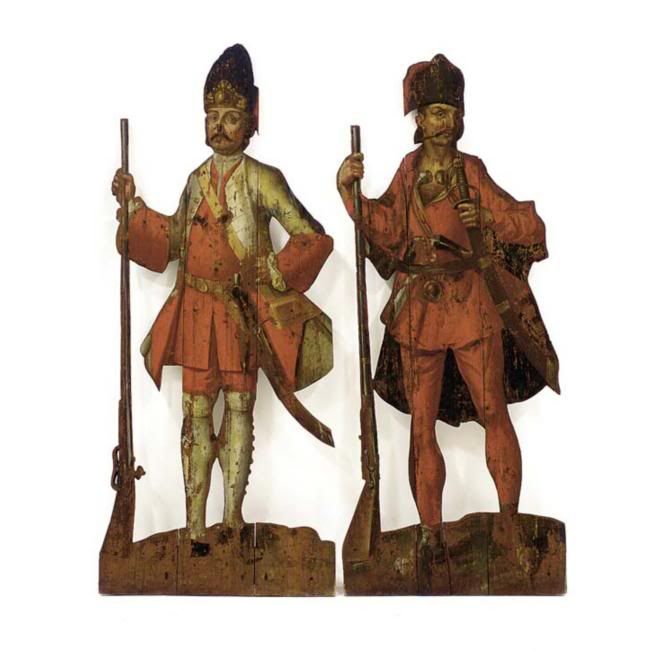
 'Two Polychrome Painted Dummy Board Figures of an Ottoman Soldier and an Imperial Soldier'

This description comes from the Sothebys auction listing but I'm pretty certain the figure on the right is a Pandour not an Ottoman, due to the pistols, the cape, the clothes, the busby and the fact that he was painted as part of a set with an Austrian Grenadier. I'd say this is my favourite of the lot, I'd never seen figures like this and they are quite large (209 and 206 cm tall) and very detailed.

Unfortunately the site is not overflowing with items like these, just the odd bits and bobs that have come up for auction every now and then. It really makes you wonder how much stuff like this is tucked away out there in private collections that we don't know about. Then again, perhaps we do know about them and it's just me who's seeing something new.

If you wanted to have a look for things yourself go to this link and use the search box in the top right hand corner. Then, once the search results come back as 0, click the 'Sold Lot Archive' tag in the middle of the page. A word of advice if you do decide to have a look; don't make your searches too specific unless you know the name of an artist. The two Imperial figures were found with the search term '18th soldier', with the 18th being for the century (if you put '18th century' it won't throw up items that have '18th and 19th centuries' for example). Image quality can also vary considerably, with the older auctions being especially blurred.

Also, I'm having luck on the painting front and seem to have hit my stride. I should have a unit of American Rangers painted and based by the end of the month. Fingers crossed.

Monday, 13 December 2010

Free French & Indian War Books

Hi there. It's been a bit of a gap and I have still not added a single photograph of a painted miniature to the blog since I last posted, but I have just compiled another list of public domain books (with a pair of silent films), this time focussed on the Seven Years War in North America alone. There are a good 50 or so, most of which are first hand accounts in the form of memoirs, journals and orderly books. They can be reached by following the link in the top, right-hand corner of the blog, or by clicking here.


And while I've been nosying around the internet looking at various French and Indian War material I found the above video on youtube. It's a deleted scene from Last of the Mohicans (deleted from the Region 2 DVD of it at any rate) and I can't for the life of me figure out why. It's only two minutes long, must have took a good while to shoot and actually fits in with the film quite well (they even mention that Duncan will create a diversion). Anyhow, if you like the thought of volley-firing British Grenadiers you'll like the clip.

Now, I should probably explain my breathtaking lack of progress on the painting front. I've had a good break from painting for a while but cleaned up a huge chunk of the SYW miniatures I've got lying around (French Hussars, Arquebusiers de Grassin, Hessian Jaegers, Freikorps and Artillery) but, following the disaster that happened with my spray paint the last time, I'm waiting for the perfect opportunity to get them undercoated (ie. when everyone who'll whinge about me using spray paint in the house has gone out for the day). I have, however, got a number of FIW miniatures undercoated from over a year ago which will probably be receiving paint over the next week or so. But if you don't see any photographed and slapped on this blog by the new year you're welcome to rebuke me for my slothful ways, in as forceful a manner as you like.

Saturday, 11 September 2010

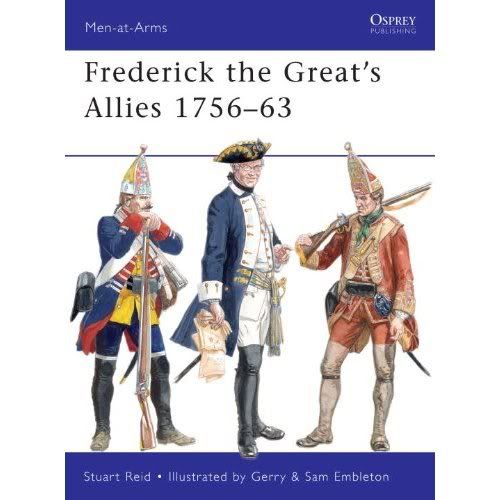
Osprey MAA 460: Frederick the Great's Allies Review


I picked this up in Manchester's Ian Allen Bookshop today and thought I'd write a little review based on my first impressions. I haven't read it cover-to-cover, but I have skimmed through it excitedly on the bus home and I am pretty pleased with it. My major worry was that the majority of the text would be devoted to a narrative of the campaign in the west, with only a few pages devoted to uniforms (like the last book of theirs that I bought on the Belgians in the Great War). I was pleasantly surprised when I found that only the first three pages focussed on the course of the campaign; the remaining 40-odd pages are devoted to the organisation and uniforms of His Britannic Majesty's Army in Germany.

Stuart Reid divides the book into sections based not on nationality but, more usefully, arm-of-service (Cavalry, Infantry, Technical Troops and Light Troops) which allows him to give a useful introduction to the themes that apply to the troops of all contingents. Following on from this, each section is further divided by nation. The organisation and uniforms of each are explored with lists of facing colours provided for the larger contingents. From my (somewhat small) general knowledge of the period it appears that nothing is missed out and certain confusions could well have been solved, Frei-Regiment von Gerlach for example (see bottom). This main section of the text is illustrated throughout by annotated, black-and-white copies of the Knotel plates and the cigarette cards that can be found in colour on the internet. Reid seems to have made good use of primary source material and usually states where he has got his information, or which conflicting bit of info he has gone with and why (with the plate for the British 51st Regt being a good example, as it differs from what is often described).

The plates themselves are beautifully done, oozing in charm and character. Since the plates are often what we buy these books for I've included a list of what is covered, below. I think that the plate space is well used, with the contingents all getting at least some attention. Given the polygot nature of the Allied army in the west it is inevitable that the plates cannot fully cover all arms of service from every contingent, but the main text does not seem to leave anything out.

Plate A: Hanoverian Infantry (Grenadier, Fussgarde-Regiment 1757; Musketeer, Hardenberg 1759; Musketeer, Sachsen-Gotha 1759)
Plate B: Hanoverian Cavalry (Grenadier, Grenadieren zu Pferde; Cuirassier, Hodenburg; Prussian Dragoon, Nr. 9 Holstein-Gottorp)
Plate C: Light Cavalry (Prussian Hussar, Nr. 5 Reusch; Hanoverian Hussar, Luckner'scher Frei-Husaren 1757; Carabinier, Buckeburg contingent 1758)
Plate D: Hanoverian Light Troops (Mounted Jager, Freytag'scher Freikorps; Grenadier, Scheither'schen Freikorps; Musketeer, 1st Battalion Legion Britannique)
Plate E: British Contingent at Minden (Private, 51st Foot; Grenadier, 25th Foot; Trooper, 6th Dragoons)
Plate F: Hesse-Kassel Contingent (Grenadier, Leibgarde zu Fuss 1760; Fusilier, Fusilier-Regt von Berthold 1760; Musketeer, Frei-Regiment von Gerlach)
Plate G: Brunswick Contingent (Hussar, Husarenkorps; Officer, von Imhoff; Dragoon, von Bibow)
Plate H: Technical Troops (Hanoverian Pontoonier; Hesse-Kassel Artilleryman; Scheither'scher Freikorps Artilleryman)

The reason I've included a full list of what is covered by the plates is that I have been dissappointed with the plates in some of the Men-at-Arms series in the past. Whole pages devoted to Guard kettledrummers in special parade dress and the like spring to mind. Or, more recently, a two page spread of Belgian soldiers assaulting a trench with absolutely no plate commentary at the back whatsoever. Frederick the Great's Allies hits the nail on the head, in my opinion. Every plate contains three uniforms that would have been seen on campaign, and every uniform has an informative commentary at the back.

Overall, I'm very happy with this book. I think Stuart Reid has done an admirable job of creating as full a breakdown of the organisation and uniforms of the army as is possible in the 48 pages allowed by the Men-at-Arms format. That he has done it in such a logically structured, engaging manner is all the more to his credit.

I don't pretend to be an expert in the field to any degree and if you have any thoughts on the book, or feel I haven't quite got this small review right, please feel free to add your comments below.

Frei-Regiment von Gerlach

I just thought I'd add a little tidbit of information I got from the book regarding this unit. I was asking on TMP about the unit a few months ago, and it seemed that it didn't show up in any Hessian OOBs and there was some doubt as to whether it existed altogether. Stuart Reid indicates that the unit began as Major Rall's battalion of Chasseurs, being first made up of contingents from various Hessian regiments in their original uniforms. These were then replaced by the uniform shown elsewhere in the blog. Unfortunately, Reid doesn't provide his source for this, though I attribute this more to the short format of the series not allowing for proper citations as opposed to any failings on his part. The fact that he goes to lengths to provide his sources throughout the book for any uniform-related choices (eg. British 51st Foot and Scheither Corps Artillery) makes me quite happy to accept his version of the history of the unit. Interestingly, the plate of Frei-Regiment von Gerlach has them depicted with lapels, as opposed to the version from the cigarette card. Perhaps the Pengel and Hurt version (which I haven't got) shows them with lapels?

Monday, 9 August 2010

Jumping the gun...


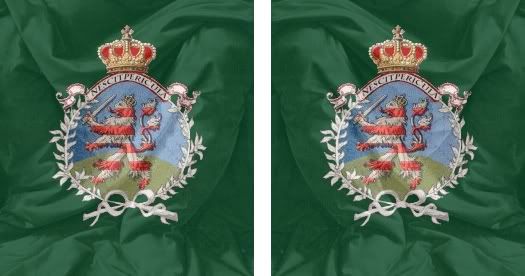
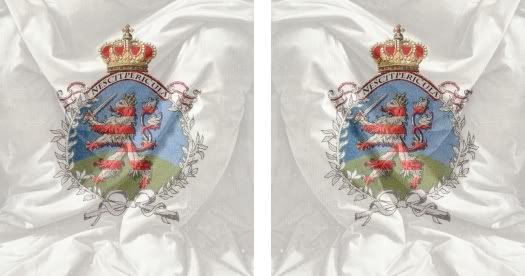
...or that's what it feels like, making the flags for a unit when I've only managed to paint one miniature. However in this case it's more of a necessity. As we don't know what flags Frei-regiment von Gerlach had (if they existed at all) I've decided to create some myself, and the only decent laser printer I have access to will become somewhat unaccessible when my current job ends at the end of this week. For the flags themselves, I've used one of the later Hessian flag designs by Frédéric Aubert from Kronoskaf as a basis. The later flag seemed to be appropriate as Prussia's allies in the west introduced a greater variety of light units towards the end of the war (Hannover with its British Legion, Brunswick and its Volontaires auxiliaires, etc.).

Creating the flags wasn't as hard as I'd thought it would be. On NBA, David said that he'd added texture to his flags by importing the texture as another layer. I don't have the program that David uses but found a youtube tutorial for something similar using the free 'paint.net' program. For a suitable texture I used a portion of one of Da Vinci's drapery studies and followed this tutorial on youtube. Later I did a google image search for drapery study and found a large number of images with more suitable folds for a rippling flag, but I'd already done these and can't be bothered changing them, to be honest. This method won't replace the high printing quality of commercial flags like GMB, but for making hypothetical flags it's a lot easier than painting freehand (which I don't think I have the skill or patience for anyway!). The flags are relatively plain (compared to the line regiment versions) which I thought was more fitting for a Frei-regiment. I plan to have a stand with four standard bearers on, as I like the depictions in Rochling et al's paintings of Prussian regiments with their stand of a few colours and I've got a couple of extra colour bearers who are just gathering dust in the lead pile. As I'm planning a large regiment of 60 or so (I'm trying to build kleinkrieg forces with only a few units a side, but a larger figure to historical numbers ratio), I don't think the four colours will overpower the unit as it might a small one.

Saturday, 7 August 2010

Getting There, slowly...possibly surely


Well, after four months of lying abandoned, half finished in my drawer, I've finally finished painting a miniature. Apologies for the slighty blurred photos although this is a bonus in my case, as you can't see how thickly the paint's been laid on. The crossbelts look especially chalky, for want of a better word.

When I promised in my last post that I would have a unit done in a months time this wasn't the intended one. I'd spent ages cleaning up a unit of Hessian Jaegers, but these fell victim to disaster while I was spraying on the undercoat (moisture in the air/using the dregs in the can/not shaking the can enough/spraying in a dark shed and not seeing that they were turning into black blobs -the last two are more likely, to be honest). The undercoat turned a streaky black/dark grey combination when I left them outside to dry.

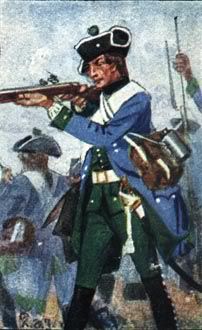
The miniature I've painted is one of the 'semi-mythical' Frei-Regiment von Gerlach. A couple of TMP posters (David from NBA and Crogge1757) indicate that the unit probably didn't exist at all, but I had my heart set on the unit after I found the old cigarette card for it on the excellent Grosser-Generalstab website. The uniform card is below:


The reason there is only the one of them is that this was finished as a test. I was doing 6 in a production line but I wasn't happy with the triad I used on the musket stocks and satchel. I decided to finish one off to make sure I was happy with the rest of the colours I'd be using. With any luck I'll have the first company of 12 done only shortly after the end of the month-long deadline. I'm going on a pre-booked holiday in a week or so's time, but this is offset by the free time arising from ending of my contract in a week's time, so it's back to this for me.

Another book has been added to the list:
Memoirs of Field Marshal Leopold Count Daun

Edit: And I've just noticed I've missed a bit!

Thursday, 22 July 2010

What a waster...

Next week turned into next month, next month turned into next season, and this blog nearly turned into one of the umpteen blogs that died after the first couple of posts, taking up a name that another prospective blogger had their heart set on (for a prime example go to goldensun.blogspot.com: I'm guessing we're not going to find out if Mellanie's boyfriend ever began to understand her). I wish I could blame a busy schedule for my but in truth it is laziness  that is the cause of the lack of updates. So much for a blog motivating me to paint up the lead pile, after 4 months I've painted six sets of hands and faces, 6 waistcoats and basecoated one tunic. I hereby swear, before all several of you, that by this time next month I will have painted one SYW unit (no excuses).

Shwerin at the Battle of Prague from the book by Kugler (see below)

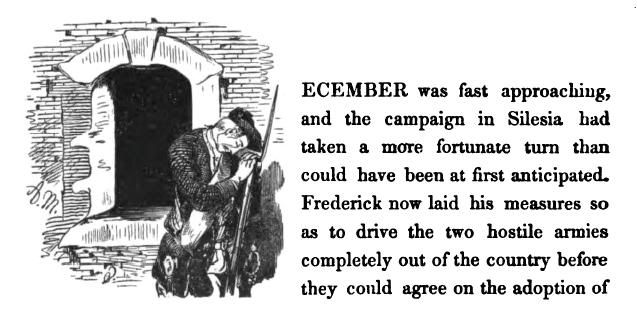
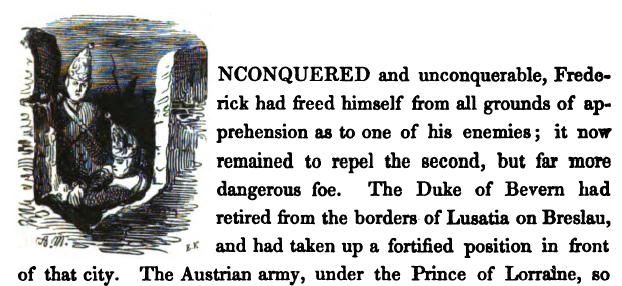
The main reason for this post after so long is that I started searching for more books after I had had the SYW on the brain while booking rail tickets to go to Foundry's open day in Nottingham tomorrow. I almost immediately stumbled upon Kugler's Life of Frederick the Great. This book is the source of all the beautifully evocative Menzel prints that you see in the Ospreys on the Prussian Army of the Seven Years War. The sheer number of them is staggering; there is an illustration every couple of its  four hundred and odd pages, with lovely old-fashioned picture letters at the beginning of each chapter. 

 The greatest ever letter D

This letter U makes me wish my employer would rethink it's Arial only policy. I'd love to submit a report where the boss is confronted with a Prussian Grenadier staring blankly back at him.

A cursory glance makes it seem like the book is a nice easy read, full of the little anecdotes that make the period such a joy to read about. I doubt i'll be able to read much of it off of a nauseating computer screen, though. A link to the book is below, along with links to a few more:

Franz Kugler, illustrated by  Adolph Menzel

Henri de Catt
(Thanks to David of Not by Appointment for this book which gives real insights into Frederick's character)

The History of the Seven Years War in Germany (1843)
Johann Wilhelm von Archenholz, Frederic Adam Catty


Sir Julian Stafford Corbett

Friday, 9 April 2010

SYW Fiction for Boys

Chris (boy wonder x) on TMP brought a fictional book to my attention, With Clive in India and I've found another by the same author, With Frederick the Great. I've always liked this sort of 'Boys' own' fiction and it's nice to see some with an SYW theme. Both are available thanks to the generosity of the people who supply Project Gutenberg with books.

If you don't fancy reading them, I'd recommend downloading the Frederick the Great one for the pictures and maps. The links to these are below, as are some of the pictures:

With Clive in India
by George Alfred Henty

With Frederick the Great
by George Alfred Henty


Three More Free SYW Books

I've found three more books but it feels like this is it, to be honest. Every search term I use brings up the same few books over and over. I've added them to the list but also included them below to save you looking through again trying to figure out which three are the new three.


De Ligne was an officer from the Austrian Netherlands who served in many of the major battles of the Seven Years War including Leuthen. There are a good 40 or so pages devoted to that period in this book as well as a dozen or so more related to his time spent with Frederick the Great after the war.

By O. P. Gilbert

Thursday, 8 April 2010

Free (Public Domain) SYW Books

I've just posted links to all of the Seven Years War books I've been able to find so far that are hosted on Google Books and the like. I'm sure somebody has compiled a better, more comprehensive list of public domain SYW books, but I haven't been able to find one yet so I've just stuck up what I've found(approx 40).

Mostly, the originals have been scanned in by university libraries meaning that the viewing quality of the books varies. I've only found time to read a couple so far (can't read books on a computer screen to save my life) but of the ones I've read I'd recommend the biography of Seydlitz. It's full of the funny little anecdotes that make this period a pleasure to study, and the quality of the scan is very good.

You can get to them by following the link in the top right of the blog or clicking here.

Tuesday, 6 April 2010

Visit to Leuthen, 5th December 09 - continued


Here are some more photos from Leuthen. I've only just figured out how much easier it is to upload photos if you select the new editor in blogger.

The monument to Frederick's victory viewed from the north on the road between Frobelwitz and Borne. Hopefully this photograph illustrates the gentleness of the rises in the ground that are overemphasised on a lot of the maps we are used to using. When i was walking down the road looking for the Schonberg, I was on the lookout for a relatively steep hill like the one hinted at on the map below, and was therefore very surprised to spot it on such a flat horizon. That said, the photo in the previous posting shows that, despite its low gradient, it provided a commanding view that helped Frederick assess the Austrian position.

Sunday, 4 April 2010

Visit to Leuthen, 5th December 2009 (with photos)

With my temporary contract at work coming to an end, and with holidays still needing to be used at a time when nobody else would be free, I decided on a whim to visit the battlefields of Austerlitz and Leuthen on their respective anniversaries which, thanks to Ryanair and Easyjet, turned out to be relatively cheap. My visit to Leuthen proved to be the more rewarding of the two by far (Austerlitz ended in farce to be honest, but I didn’t really research before I went so I got what I deserved). Leuthen was the first battlefield I have properly visited, let alone written about, so you’ll have to excuse me if the following post reads like the ramblings of an idiot interrupted now and again with poorly-taken photographs.